
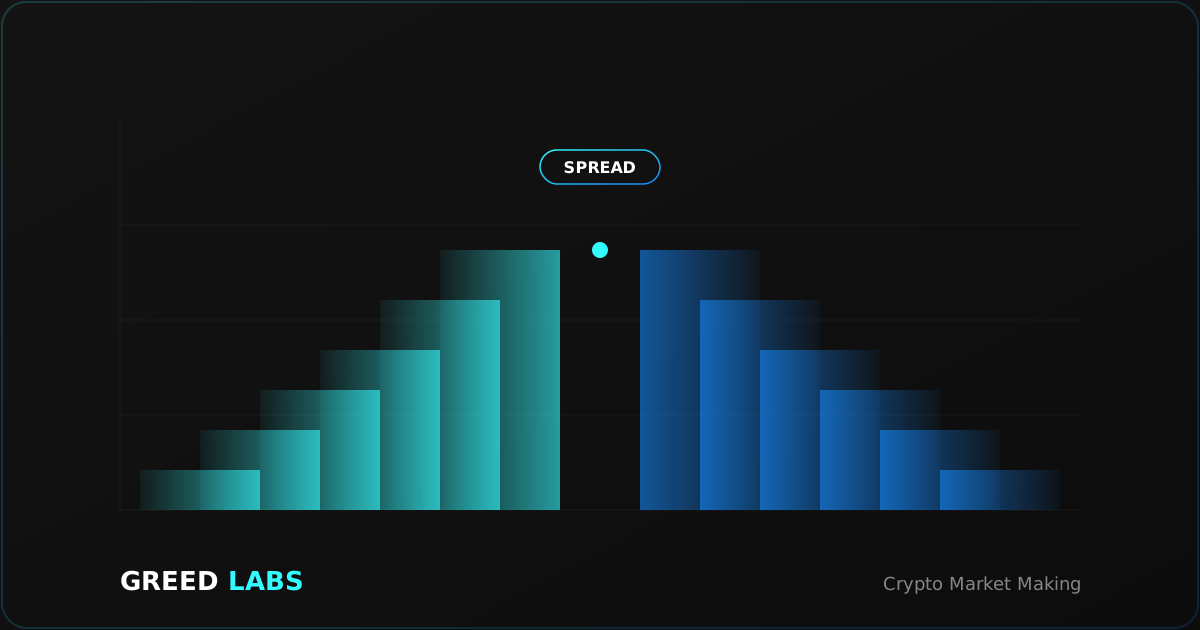
A market maker places resting limit orders that sit on the order book and add liquidity, while a market taker submits orders that immediately fill against those resting orders and remove liquidity. The distinction is not about who the trader is — it is about what their order does to the book. The same account can be a maker on one trade and a taker on the next.
This guide explains how each role works, how exchanges price them differently, and why the difference matters for token projects.
The core difference
A market maker posts a limit order at a price away from the current market — a bid below the mid price or an ask above it. That order does not execute right away; it rests on the order book and waits for someone else to trade against it. By sitting there, it adds depth and gives other traders something to buy from or sell into.
A market taker does the opposite. They submit a market order, or a limit order priced to cross the spread, that matches instantly against the best resting orders. Execution is immediate and effectively guaranteed, but the taker consumes the liquidity a maker provided and pays the spread to get filled now.
| Market maker | Market taker | |
|---|---|---|
| Order type | Limit order that rests on the book | Market or marketable limit order |
| Effect on liquidity | Adds liquidity | Removes liquidity |
| Typical fee | Lower fee, sometimes a rebate | Higher fee |
| Execution | Not guaranteed — waits to be filled | Immediate |
| Price control | Sets the price, gives up on timing | Controls timing, gives up on price |
Maker-taker fee model
Most exchanges use a maker-taker fee model that prices the two roles asymmetrically on purpose. Makers pay a lower fee than takers, and some venues go further and pay makers a small rebate for every order that adds liquidity.
The logic is straightforward: deep, tightly quoted order books attract traders, and traders generate volume and fees. So exchanges subsidize the participants who supply that depth — the makers — and recover the cost from the participants who consume it — the takers. Lower fees and rebates are the incentive that keeps resting liquidity on the book.
The exact numbers vary by exchange, by trading pair, and by a trader's volume tier, so the takeaway is relative rather than absolute: makers are consistently charged less than takers, and the gap is what nudges liquidity providers to keep quoting.
Why it matters for token projects
For an individual trader, the maker-taker distinction is a cost-and-timing trade-off. For a token project, it explains a structural problem: takers only consume liquidity, so someone has to continuously provide it.
Retail traders and speculators are overwhelmingly takers. They hit the best available price and move on. If no one is posting resting limit orders on both sides of the book, there is nothing for those takers to trade against — spreads widen, depth disappears, and every order moves the price. A token cannot rely on organic order flow alone to stay liquid, because that flow is mostly one-directional demand for immediate execution.
That is why projects engage a dedicated market maker. A professional maker keeps live bids and asks on the book around the clock, absorbing buy and sell pressure and keeping spreads tight regardless of which way the crowd is leaning. The takers get a market they can actually trade in; the maker earns the favorable fee treatment for supplying the depth that makes it possible.
See our guide on what crypto market making is for the bigger picture on how dedicated liquidity provision works and why token projects rely on it.